

A community response
Local organisations, faith groups and elected representatives came together because too many single people had nowhere realistic to turn.

Our history
Accommodation Concern grew from local organisations meeting in 1985 because people facing homelessness in Kettering were being passed between services without clear, reliable information about where help could be found. In 1986, those roots became the Local Emergency Accommodation Project, known as LEAP.
Our services, partnerships and reach have changed considerably. The principle behind LEAP has not: people facing homelessness or crisis need practical help, trusted advice and someone prepared to work alongside them.
 1986
LEAP begins
40 years
of advice, support and housing
1986
LEAP begins
40 years
of advice, support and housing
What changed
Local organisations, faith groups and elected representatives came together because too many single people had nowhere realistic to turn.
Rent deposit guarantees, advice and resettlement helped people move from crisis into homes they could actually access.
Housing problems were rarely just housing problems, so AC developed benefits, debt, tenancy sustainment and practical support.
Today, frontline evidence helps us shape financial resilience, mental health advice pathways and supported accommodation locally.
The early years
The story starts in late 1985, when voluntary and statutory organisations began meeting in response to a growing local homelessness problem. LEAP was then incorporated on 2 September 1986 to provide emergency accommodation, care, support and resettlement for homeless single people over 16 in Kettering.
The aims went beyond a roof for the night. From the beginning, the work included advice, counselling, employment support, training and education, helping people move towards a more settled life in the community.
In the late 1980s, Accommodation Concern secured government funding for a rent deposit guarantee scheme. For people locked out of private renting because they could not raise a deposit, this was practical prevention before that language became familiar.
Timeline
An archive Kettering clipping shows that the town was wrestling with homelessness and local relief long before AC existed. It is not our origin story, but it reminds us that the issue has always been part of local life.

Voluntary and statutory organisations begin meeting because people facing homelessness are moving from service to service without one reliable source of accommodation information.
The Local Emergency Accommodation Project is incorporated on 2 September 1986 to provide accommodation, care, support and resettlement for homeless single people.
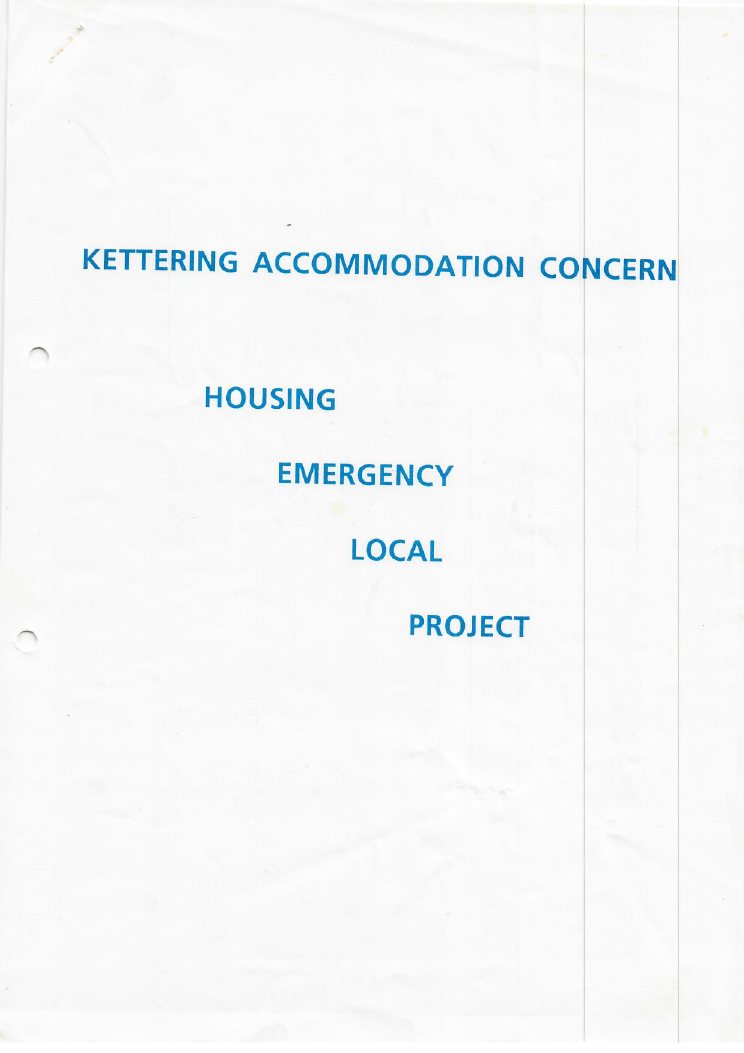
The Accommodation Concern identity is adopted and the original charity is registered on 9 December 1987, bringing a clearer public name to the work.

Accommodation Concern is formally launched on 28 November 1988. Early work includes shared accommodation lists, rent information and Housing Benefit guidance.
A part-time information coordinator is appointed, maintaining lists of rooms, hostels, private landlords and other accommodation for local agencies and the press.
One of the earliest annual reports currently held in our archive shows a small London Road organisation with limited funding and a clear commitment to practical housing help.

Accommodation Concern launches the Housing Emergency Local Project rent fund, a practical revolving fund designed to help people on low incomes access private rented accommodation.
Funding from the Department of the Environment helps develop H.E.L.P. and establish a permanent advice service. A full-time Advice and Development Worker is appointed and a public office opens at Beacon House.
The rent-fund model produces strong results, AC works with mental health services and probation, and the organisation shares learning nationally about rent-deposit schemes.
AC expands advice and resettlement work, strengthens landlord relationships and develops prevention activity through schools, youth justice and community partners.
Welfare reform makes access to private renting harder for younger people. AC records young people sleeping rough and expands school-based prevention work about leaving home, rights and homelessness.
National Lottery funding enables AC to appoint a dedicated Young Persons Worker, expanding school seminars, assemblies and early support for young people at risk of homelessness.
Demand reaches record levels. AC provides housing advice, landlord liaison, court support and emergency assistance, while public appeals help find rooms and raise awareness.

AC operates through a formal local authority service agreement, with open-access advice, appointments, emergency assistance, landlord recruitment, resettlement and outreach.
The activities and assets of Kettering Accommodation Concern transfer into the current charitable company, creating a stronger legal and governance foundation.

AC grows supported accommodation alongside housing, benefits and regulated debt advice, reflecting the link between housing, income, health and wellbeing.
AC adapts delivery while keeping essential services running for people facing homelessness, financial hardship and isolation.
Specialist housing, debt and welfare benefits advice becomes connected with Northamptonshire NHS mental health services, recognising that safe housing and financial stability are part of recovery.
As AC's supported accommodation grows, the organisation helps establish North Northamptonshire's Supported Accommodation Multi Agency Panel to improve referrals, risk management and standards.
National funding supports a digital debt referral route and AI-assisted transcription, reducing repetitive administration while keeping professional judgement and quality assurance at the centre.
AC leads the North Northamptonshire Financial Resilience Theory of Change and helps establish the Financial Resilience Partnership, using frontline evidence to shape more preventative local systems.
AC remains rooted in frontline delivery while increasingly acting as a convener, thought leader and system partner across housing, advice, health, financial resilience and supported accommodation.
We are preparing for supported housing reform, strengthening quality and resident involvement, and growing only where it meets local need and improves people's chances of lasting stability.
Today
Housing and homelessness remain central to our identity, but experience has shown that housing problems cannot be solved in isolation. Rent arrears may be linked to a benefit decision, debt, sudden loss of income, poor health, relationship breakdown or unsuitable housing.
That is why AC now brings together housing advice, welfare benefits advice, regulated debt advice, supported accommodation, tenancy sustainment, emergency help, employability, community outreach and partnerships with health services, councils, landlords and community organisations.
Next chapter
Our future is not about moving away from frontline delivery. It is about making sure the knowledge gained from frontline delivery is heard and used.
AC is increasingly asked to bring frontline evidence into strategic discussions, identify gaps, convene partners, involve people with lived experience, design referral routes and influence preventative pathways.
That work is visible in the Supported Accommodation Multi Agency Panel, the Financial Resilience Partnership, NHS mental health advice pathways and our preparation for national supported housing standards and licensing.
The legacy of LEAP is not just a date in our history. It is the belief that people need more than information or signposting. They need practical help, specialist advice and someone who will work alongside them.
Our purpose remains